Showing posts with label field trips. Show all posts

Wednesday, November 1, 2017

Cotton Gin Tour

It's cotton harvest time! We visited a local gin to learn about the harvest process. 


The cotton arrives in modules, which are made up of many bales.  One module can weigh about 20,000 pounds!  


The yellow loads are cleaned bales of cotton, packaged for shipment.  Each bale weighs about 500 pounds.  There are many bales on those trailers. 


This is raw cotton, ready for processing.  See how dirty and full of debris it is? 


A close up of the module of cotton, fresh from the fields.  Each module is recorded by a system that tracks it to its final destination.  They can track it back to the very field in which it was grown even after the cotton reaches textile plants in Asia, if needed. 


This is the mechanism that moves the modules off of the flatbeds onto the conveyer system to begin the ginning process. 


Inside this machine, there are pickers that spin and break the cotton off of the modules and allows it to be suctioned into the next place, where it will be "ginned", or have the seed removed from the cotton, which is called 'lint'. 


See the fluffy cotton on top? It's getting ginned and the seeds are being separated below.  They look yellow in the picture, though they are white. 


Here's the difference from the raw cotton (right) and the ginned cotton (left). 


See how cute the cotton seeds are? 


Control panels keep everything going as it should.  I do have to say, it was SO LOUD INSIDE THAT YOU COULDN'T EVEN HEAR YOURSELF YELL! All the workers used ear and eye protection and many also had masks to breathe through. There was lots of cotton fiber in the air!  


This is after the cotton has been further cleaned and combed.  See how silky it is?!


This baling machine collects the finished cotton and presses it into 500 pound bales. 
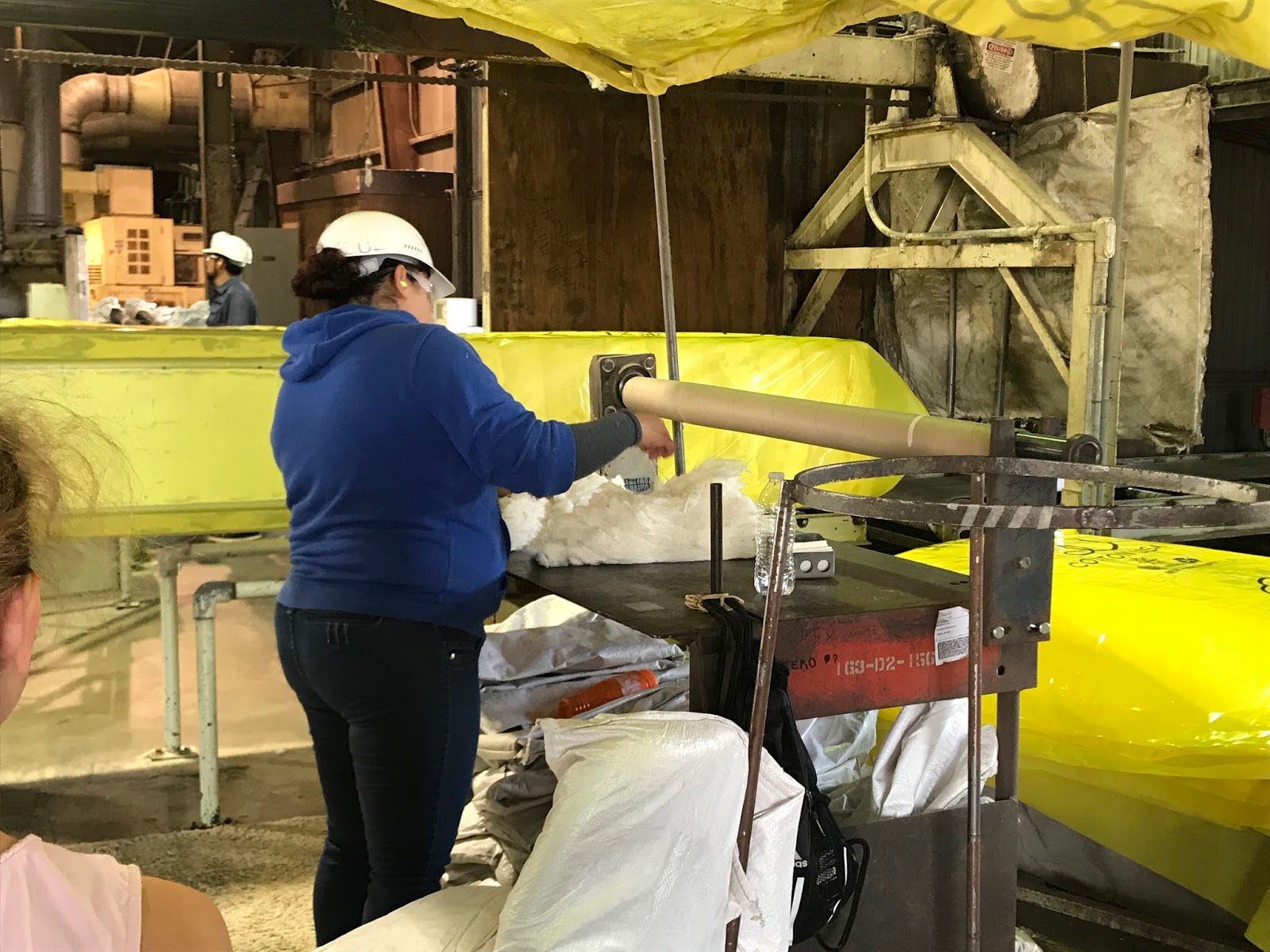

Samples are taken from each bale.  One goes to the government for inspection, grading and pricing, the other back to the grower for his records. The yellow bag is sealed and loaded onto trucks for shipment.  Most of the cotton we grow here in Central CA is grown for the seeds.  The seeds are sent to other states for their crops, as well as kept for replanting for our farmers.  The cotton is exported all around the world, especially to Asia, for use in textile production. 


Here are all the parents and kids who participated in this tour.  This giant pile of seed was not of good enough quality to plant, so it becomes cow feed. Other discarded seeds may be sent to be pressed for cottonseed oil. 


After the pictures, the kids were allowed to conquer Cotton Everest. 


Such a fun trip!  

If you want to learn more about cotton, may I suggest a few books?  


To contrast cotton and wool in textile production: Charlie Needs a Cloak

And for moms who might want to try their hand at spinning: 


Wednesday, August 8, 2012

Chinese Cultural Center Visit

The other day we went to the Chinese Cultural Center for the first time.  We drive past it often, but had never stopped by before. We learned about the real lives of Confucius and Buddha during Mystery of History last year and I thought this would be a nice complement to that study. Here are the kids, squinting into the sun because if they faced the other way, the pictures was all washed out.
These two garments were on display. The white one looked older than the black one and was exquisitely embroidered.  The darker one looked machine sewn to me.
 Here's a close up of the stitching on the white garment.
 There was lots of art on display, too.
 This drum was crying out to be pounded, or so my little boys thought.  They controlled themselves very well, though, so I allowed them to thump their fingers on it softly before we left.
 This statue was outside, baking in the sun,  The plaque was entirely in Chinese, so we didn't know who was depicted.  I suspect it was Confucius, though.
Something that would have made it better would have been for a guide to have been there. The only other person we saw was a Spanish speaking housekeeper. I asked her if there was an attendant, but she said she was the only person there. It was a fun little field trip regardless, and I am glad that we finally made the time to stop by.

Tuesday, July 5, 2011

Tide Pool Study

We went to the Oregon coast and were blessed to be able to see some tide pools. While walking to them, the Lambies collected random crab parts. Later, they assembled the fine specimen you see above.


Many of the children spent the 2010-2011 school year in "Exploring Creation with Zoology 2: Swimming Creatures". Therefore, these animals were familiar and they had *that* much more fun seeing what they had studied.

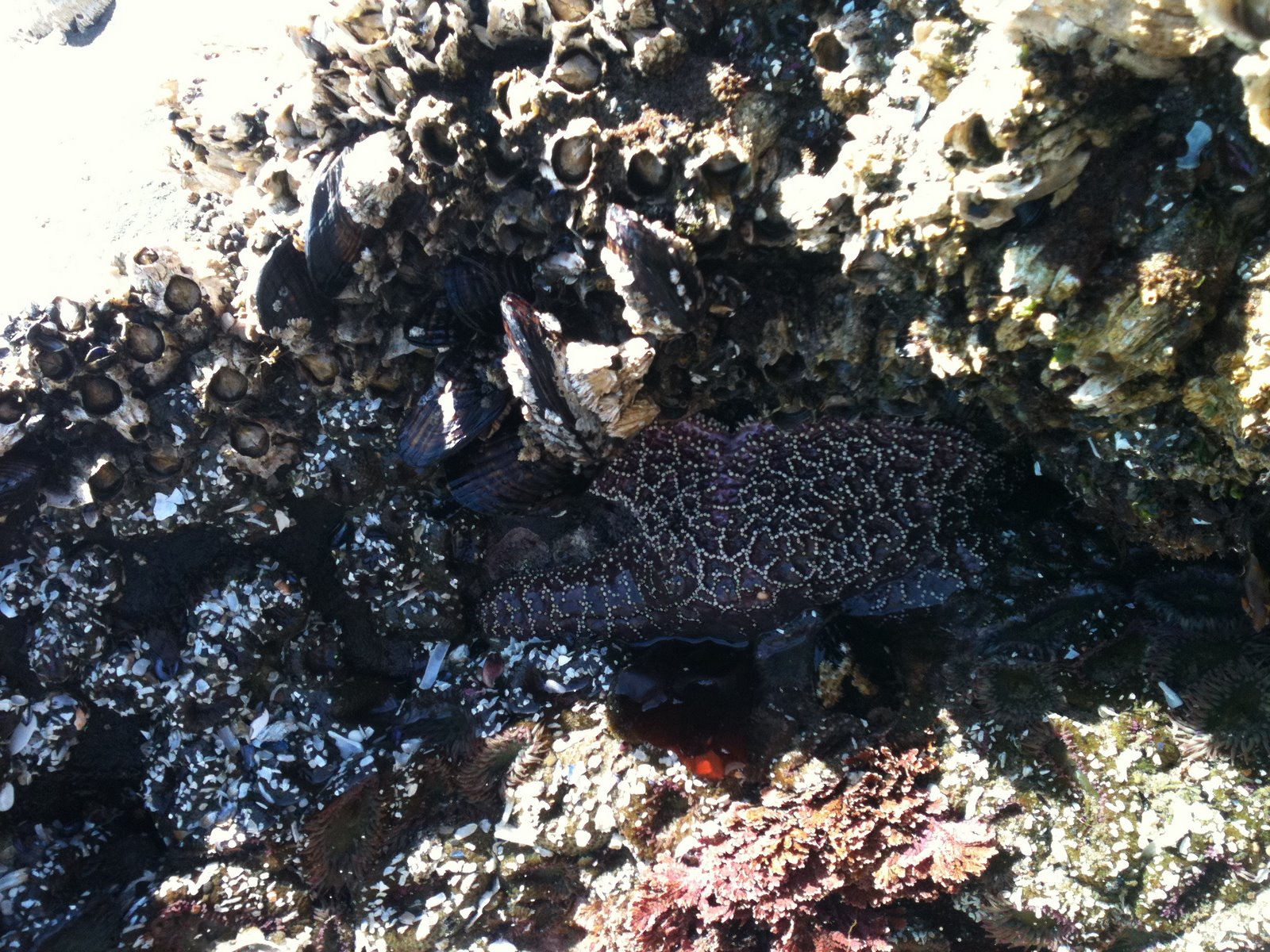
Someone else pried this starfish off of his shelf and left him out on the rocks, upside down and vulnerable. We held him for a little while, noticing his rays, suckers, eyespots and mouth. Then we returned him to a pool, in a safe location.


There were SO many mussels! We recalled reading in "Pagoo" that they sent out strings to anchor themselves. Looking carefully, we did indeed see byssal threads! We also identified several kinds of seaweed and sea grass. We had a great time, learning and playing in God's great creation!

Tuesday, April 6, 2010

Equestrian Class

I finally scheduled an Equestrian class. I found an ad on Craig's List for horse lessons and e-mailed the instructor requesting a class for the entire family instead. She was happily open to the idea and we set a date. Long story short, it was hard to get together! We finally met this morning after many e-mails and had the class. It was so much fun!

DSCF7585

DSCF7595

She had the children jump right into horse care and before too long, they knew the ins and outs of curry combs and brushes, were using the foot pick like pros, and had even learned to saddle the beasts.

DSCF7610

DSCF7614-1

DSCF7622

DSCF7635

DSCF7638

DSCF7641

DSCF7646

DSCF7648

All of the children (and Momma) took turns riding. No one was frightened and no one fell off. Everyone took turns and helped one another. The instructor seemed impressed with how the children behaved, listened and tried to put to practice what she taught. We have been invited to return tomorrow to see the farrier at work and enjoy some more riding time. She has offered free lessons in exchange for "slave labor" around the stables. What an opportunity! I know we will be learning, working and exercising a lot at the stables. So exciting!

Friday, June 27, 2008

The Bee Farm

(Originally posted on my other blog 6-27-2008)

We took a field trip to our Bee-Guy's Warehouse. We get our local, raw honey from him, and were delighted to be invited to watch the collection process.

The hive boxes had been picked up that morning to be taken to various fields, but many, many bees were still around. They were especially thick near the line where the honey is extracted. All the children behaved just as I told them to and did not swat at the bees that came near. No one was stung during our visit; they didn't even seem to notice them after the first few minutes.

There were thousands of frames waiting to be emptied. There was lots of orange honey, some sage, even some avocado!


Here's a look at the line where the honey is extracted. The frames were put into one end of the line. They met "The Capper" which quickly saws off the wax cap that keeps the honey in the individual cells.

Then the frames go down the line and are put into a centrifuge. Many frames fit in at once. The spinning forces the honey out of the cells, onto the walls of the centrifuge. It then drains to the bottom and is collected.


The children were given spoons and allowed to taste the honey oozing out of the cells after then were opened. Yummy! We were able to taste more after it was strained, too.


We were given a bucket full of honeycomb. Most of the children liked the honey, but not chewing the wax. I guess that is a pleasure of a by-gone age.

The fragments of wax cut off the frames, and all that is removed when the frames need cleaned are collected in 50 gallon drums. Not very pretty, is it? The dark spots are dead bees.

It is heated and strained, and collected in buckets. When cooled, the wax is gathered on pallets, ready to be shipped off for candle making. Some also goes to cosmetics companies.


Here is our group in front of the warehouse.Have you any idea how hard it is to get a picture of that many little ones looking at you? Sorry to those who have silly expressions; this was the best one :) .

Monday, May 19, 2008

A Hobby Farm

(Originally posted on my other blog 5-19-2008)

We took a trip recently with some friends to another friends farm. This friend is supplying our family with fresh, fertile eggs and -wow- are they delicious! She is enjoying our homemade freshly ground wheat bread in exchange. I love barter!

Here are "our" chickens.

We discovered a duck, secreted away, laying on her eggs.

She has an aviary, complete with nesting doves, like this one, parakeets and other lovelies.
Here is a guinea hen, who gives us small, very hard shelled eggs.

Here are some adorable chicks.

And one of the many goats. He is in need of a good shearing, but he's so handsome!

Here are a few of the children near the dear donkey.

We had a great day! Thanks for the invitation, Tammy!