Showing posts with label planning. Show all posts

Tuesday, August 7, 2012

Back-to-School Interviews


I have posted how I plan our school year before, and even once before that, but have never posted about our Back-to-School interview.  Today I will remedy that.

For the last few years, I have created a Back-to-School interview for my children.  I print it off and give each child a copy to complete.  Children who can not yet read or write get to do it orally with me.  I ask things like, "Which book you enjoy most last year?", "What would you most want to learn about this year?", "What did you least enjoy last year?" and "What do you need to practice more this year?".  There are usually 8-10 different questions of this sort.

After giving them a day to complete it, I call them to me one by one, privately, and discuss their interviews.  I find out what they didn't like about a particular book or subject; what their specific, personal interest is for the term or the year; and specifically what they think they need to work on more.  We pull books from the shelves according to their interests and later I begin working on their term work forms. I really enjoy our time talking together and getting some insight into their feelings about school.

I often craft a course specifically for a child's interest or need discussed in the interview.  For example, last year for my 10th grader, I made a Health and Nutrition course.  I chose three books for her to read and wrote down the specific requirements for her to earn her credit.  I will write out the specifics in a future post.  I made two copies of that page, one for me and one for her.  She was required to complete all the points before the end of the school year.  It helped teach her responsibility of time management and how to budget her work load throughout the Term.

For another example, one of my daughters loves to cook.  She has mastered making most of our normal meals and wants more challenge.  Therefore, this school year, she'll be doing a "World Cuisines" course. I haven't planned the entire study yet, but consists of an overview about a culture (Japanese, for example), a history of their geography and natural food sources (which greatly affect their traditional foods),  their 'stereotypical' dishes and if they are realistic or not, specific vocabulary relating to their cuisine (wok, chopsticks, etc) and choosing a few of their dishes to prepare and serve.

Our back-to-school interview makes this kind of planning easier because I can really get to know what they would like to learn about in depth.  It makes school so much more worthwhile than simply doing Math, Science and History blah-blah-blah.  To have a real personal interest to explore makes a world of difference!


Sunday, July 17, 2011

Planning 2011-2012


It's planning time again! I'll share some of the resources I am planning to use this year, along with links to some of the printables I am using.

I write out our term's week-by-week work using this form created by Linda Faye. I've used it for years and am so thankful that she made it available for all to use. Linda Faye is the creator of a great site called Charlotte Mason Help. It's a wonderful resource that should be bookmarked.

This year I printed off these cute little reading logs for the four youngest Lambies. When the book is filled, I plan to either take them out for something or get them a special treat. What that treat is, I have not decided.

My favorite attendance sheet is from Donna Young. I find her site helpful, but sometimes it's hard to find a particular page you saw that you liked. I usually make a master copy to keep on hand in case a favorite form goes missing. :)

EmBlem will continue with Apologia Science. She loves it. She'll be in Chemistry this year! GirlofGod has chosen to study astronomy in depth. She's using Jeanne Fulbright's book as a spine and other books to supplement. The rest of the children will be studying Human Anatomy, using Exploring Creation with Anatomy. Nature study will continue as it always does.

We're using Mystery of History Vol. 1 all together this year. I am not sure how it will work out, but I am looking forward to teaching history all together rather than to each child individually as I had been when using AO more closely. We'll be using our Book of Centuries as the timeline. I will likely use "A Picturesque Tale of Progress" as appropriate. I love this series!

Of course we will identify the area we are studying in MOH on the map, but the bulk of our geography will be US this year. I will use a few different resources. This free site has almost everything I'll need! I also have "Yo, Sacramento". It helps the kids remember states and capitals in a unique way.

For Bible, I am considering studying character traits this year, along with our through the Bible readings. This chart will be useful. I really like this printable record for personal Bible time. I also want to listen to J. Vernon McGee on a regular basis. The Way of the Master is very useful for learning how to share your faith.

We'll continue to do grammar, composition, spelling and such in various books depending on each child's abilities. My oldest will be doing Larry Burkett's Money Matters for Teens. I'd love to get Dave Ramsey's homeschool program to use in the future.

Some of the kids will be doing workbooks from Evan-Moor: "The Daily ______" series. They are quick and easy activities that pack a lot of punch for the time spent. I have a couple of kids who prefer this kind of independent work and I am glad to have found Renee's recommendation.

Saturday, December 25, 2010

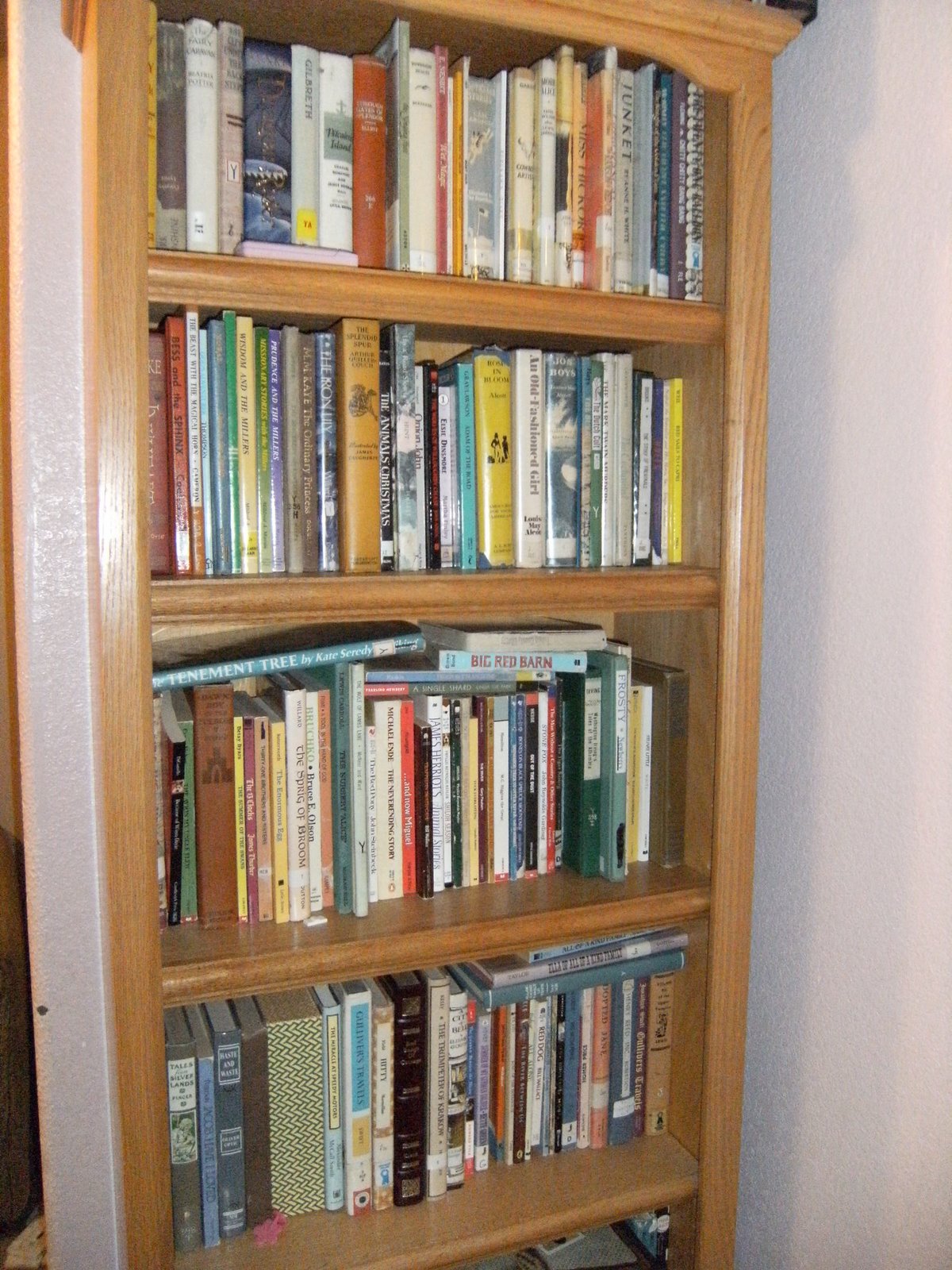
How I Organize My Books


Since I have so many books, I need to have some method of organization so I can find them when I am looking for a particular book. My library is the same size as our bedrooms, lined with bookshelves. When you walk in, if you begin at the left side, you are in the science section. I organize this section by The Days of Creation. First are topics that have to do with light, creation, etc. Then subjects like atmosphere, weather, etc. Next comes geology, water systems, plants, seeds etc. Then astronomy topics, oceans and all water creatures, birds, land animals, dinosaurs (I put fossil, evolution and paleontology books here) , reptiles, amphibians, insects, bacteria etc. Finally, I have all topics related to man, such as anatomy, human biology, digestion, etc. here. I follow these sections with groupings of books about technology, architecture, locomotion, medicine etc. etc. Basically, science-related human accomplishments, I guess, for lack of a better term.


Once past science, I begin my author/illustrator section. I collect many different authors and illustrators and keep them in alphabetical order here. Some pose a problem, like Margaret Wise Brown books illustrated by Barbara Cooney. In this case, I think of who I would first associate the book with, the author or the illustrator and shelve it accordingly. This is the funnest section of the library, I think.


Following the author/illustrators, comes some miscellaneous shelves. One holds living math books, one poetry, one musical arts (ie: composer biographies and related items), some hold series (ie: The Bible Story, The Book of Knowledge, The Picturesque Tale of Progress), one folk and tall tales, one Brothers Grimm books, one past times and how-to books (ie: drawing books, how to play chess, how to perform card tricks and illusions, etc), one Christmas books.

Next come my favorite shelves: historical. I begin this section with the Ancients. Ancient Greece and her stories, Ancient Rome, Ancient China. Each historical book I get goes on these shelves in the proper timeline order. I can find any particular book quickly since its chronological. I can also pull a section easily for a topical study. This is the largest section of the library.


Finally come the novels. Lots and lots of novels. Poor double shelved (and more, sometimes) novels. The novels begin here, but many are also shelves on bookcases in the older childrens' rooms. On occasion, I switch all the novels shelves around. This leads to the older Lambies finding books they had overlooked or never seen before.


Books that are used for our curriculum (Ambleside Online) are shelved separately in the family room by Year. I can easily move a child up or down in books, as needed, since they are already pulled and ready.

Easy reader books are in the bedroom of the child or children that are at that level. Board books are in a wicker basket in my youngest sons room. I've given away most, since he's five and we have no babies. I've kept any that are good literature for visitors and future grandchildren. Troubles looks at them still, too.

I hope you have enjoyed a peek into my library. Please tell me about your organizational system!

Saturday, August 28, 2010

Grading Helps

http://img.widgetbox.com/thumbs/4b66a8b4-015a-434e-84dd-6a74e22aa5ab.png?63

I have three children on whom I keep grades. I begin giving percentage scores and letter grades in Grade 7. I record the grades on one of my favorite forms and keep them in my teachers binder. At the end of the year, they go into the portfolio with a few samples of work. I have a paper grading chart that helps me calculate the grades, but as the kids get older, they sometimes have more problems than my grader can handle. I found this online calculator that is very helpful and thought I'd pass it along. It's now saved in my School Sites Folder in my favorites.

Grade Calculator

Also helpful for end of term or year calculations:

Grade Point Average
GPA Calculator

I haven't figured out which one I like better yet.

Sunday, July 25, 2010

Planning 2010-2011

I'm beginning the planning our 2010-2011 school year. I will share the forms that I like to use. Perhaps you will find something that will help you in your planning. Check often as I will be adding links as I use them through my planning process and not all at once.

My Preferred Attendance Chart I love the simplicity of a one-page-for-the-year chart.

Grade Record Sheet for One Child for One Year Love the simplicity of this form. I use it for my Grade 7 and up Lambies only. Younger children get 100% or they correct their work and then get a :) .

My Daily Checklist I type the name of each book and the week number across the top. Then the children check off their work as they complete it. You can read how the creator of the form, LindaFaye, uses the daily checklist here.

Book of Centuries Each child has their own Book of Centuries to personalize as they read and learn. They can add anything they choose, whether it's a school related fact or not.

A Bible Reading Chart I have several printable versions. Click the number for 1, 2, 3, 4 more choices.

Friday, May 14, 2010

Jr. High Science

I've been on the search for a jr. high science program that will work for my going-into-8th grade daughter. It's an ongoing research project.

Things I have considered:

Apologia Physical Science: too hard, but she will probably be ready in 9th grade

The Rainbow: still a possibility, but expensive, therefore, low on the list

Beefed-up Elementary Apologia: daughter doesn't want to do something easier than General Science, but this is my favorite option *ETA: My daughter didn't know there was an Astronomy book. She is excited now to do this possibility. YEAH! THE SEARCH FOR SCIENCE IS OVER!

Christian Light Publishing LightUnits: still a good possibility, but not very CM-ish I've heard, affordable

Light of Faith: still reviewing

A.C.E. Paces: still reviewing, affordable, again, not CM

Spectrum Science: cheap possibility, will preview some this weekend

Living Books Curriculum: just beginning to look....

Reading biographies, experiment books and other living science books we have on hand, keeping a notebook (as with Apologia), writing essays and performing experiments as desired.

Anyone have more suggestions to look in to? Thoughts or opinions on any of the choices I have listed? Any help would be greatly appreciated!

Thursday, January 28, 2010

The Master Planner

My friend posted this link on facebook.

The Master Planner

I looked and liked what I saw. I chose to download the package. It took less than five minutes to pay for it, download it and begin to play with all the forms. Now to get some ink for the printer....

Sunday, January 17, 2010

A Peek Into Our Binders

The children each have a binder that is anchor of our studies. It guides each childs day and shows them (and me) what they need to accomplish. Last time, I shared how I organize the schedules for each child. Here's a picture of my Y6 daughter's checklist schedule:

DSCF7027

Note how she X's off things we skip, miss or choose not to do on a certain week. Most things get a check mark. Each subject is completed before the child may check mark it. I have to verbally ok an X.

See also how there are extra lines where I have listed the books for the day? It seems that there's always something I forget to list, so it gets penciled in when we discover an omission.

Each child 2nd grade and up is participating in Geography. We are using Ann Voscamp's Explore the Holy Land. Included in geography is mapwork. I print the maps off from the included CD and they are slipped into a sleeve in the binder.

DSCF7028

I print off the AO weekly schedule for the older children, first having copied it to a word processor and adapted it as I need. I delete books we are subbing out and add in our personal changes. This helps the kids know exactly what to read, since, in the older grades, it's not always 1 chapter a week.

DSCF7029

Each child also has a pencil bag, extra lined paper for notes, and 3-hole-punched drawing paper for sketching. One child has a small atlas she found at a garage sale. Younger children have flashcards of sight words. Most of the also have a spelling dictionary. Some of the older children choose to keep their spiral notebooks (for Grammar and Spelling Wisdom) in their binders. Others keep them in their school drawer.

Next time, I'll give you a tour of our school closet.

Saturday, January 16, 2010

How I Organize Our AO Schedules


I admit it. I am a checker-off-er. I have too many things to remember to NOT be a checker-off-er. If I don't have a written record, I most likely won't remember it. Therefore, I need to have check-off sheets for the childrens schoolwork. In addition, I am constantly striving to work myself out of a job. I want my children to be able to do school themselves if I have to be away for some reason. Check-off sheets help accomplish both of these ends.

After trying numerous planners that weren't right for me, I found LindaFay's wonderful site. Her articles have been so helpful as I have developed my homeschool philosophies and goals. She has a forms site, too, I discovered. There I found the check off sheet I have used for the past two or three years. It's a perfect fit!

Here's how I organize a Year. First, I downloaded the checkoff form to my computer. I add Bible, Memory Verse, Grammar or Phonics and Math-U-See since these are daily subjects which all the children need on their lists. I save it as "Master Planner", then open it up again and rename it "Year __ Term ___" and save it again. I have folders for each Year and save the completed forms into them, so that each fall I have most of the work done and need only make small adjustments for the new year and the new student.

Next, I refer to the AO site. I go to the booklist for the Year I am planning. I print a copy of the booklist so I don't have to be flipping back and forth on the computer tabs, and I can scratch and scribble my notes and plans on the booklist as I organize my thoughts.

I choose which books I am going to use from the booklist and which I will substitute. I am not a slave to the AO booklists! If I don't care for a book, I will change, even in the middle of it, if I must! I write these on the blank back of the booklist. I add in books that I want to include that aren't on the booklist. I note which books are daily or twice-weekly reads and which are only weekly, so I can add them the correct number of times to the schedule.

Next I begin to arrange the books into the check off sheet on the computer. I sort them by subject and by difficulty. I don't want to put all the hardest books on the same day! Bible, Memory Verse, Grammar, Phonics and Math-U-See are already added in the previous step. I choose to have Monday and Tuesday our heaviest days, since we are fresh from the restful weekend. I arrange the bulk of the harder 'core' subjects on these days. I balance them out with free reading and literature. Science (Apologia) is daily for the older children, twice weekly for 3-6th graders. I add and change around the remaining books until I am happy with the arrangement.

I make sure to note if I want a written or oral narration of a certain book, because if I don't, I will forget to ask for it. I even add in "Read a story aloud" or "Help a Little with a page" in the older children's lists. I want them to be developing teaching skills as well as academic ones.

I choose to schedule all our weeks work into four days, with Fridays being reserved for fine arts, field trips, service opportunities, and catch-up, in case something unexpected happened earlier in the week. I have the freedom to drop school for a day if something fun or challenging comes up, without falling behind. That freedom is important to me.

Once I am pleased with the form, I print it out on cardstock. I slip it, back to back (since it is two pages), into plastic sleeve and it goes into the students binder. It is referred to by the child, to see what he or she must accomplish on a given day, and serves to help me see at a glance what they need to do still before earning free time.

I hope that's a clear presentation of what works for me on scheduling. Please do ask if you have any questions or need clarification on anything I have mentioned. :)