Showing posts with label Math. Show all posts

Sunday, January 6, 2013

Teaching the Teen Numbers


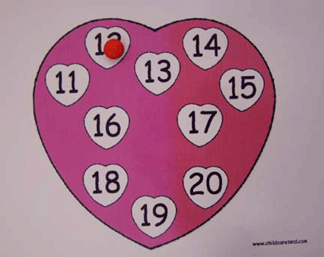
Some kids breeze through learning the teen numbers. They simply click. Others have a harder time with these numbers. They don't follow the verbal pattern of counting and that makes them HARD!  On top of that, number 17 sounds an awful lot like 70.  It's all very confusing.  Here are so helps for teaching those pesky teen numbers.

Numbers in the Teens Song

Mathwire

Marshmallow Counting Frames

New Zealand Teachers Tips

An Online Game

Montessori Math

Montessori Teen Board

A Pinterest Board FULL of Ideas


Wednesday, September 5, 2012

Starting with Money

Missy's newest endeavor is to master the art of money.  She's ten now, and needs to have this skill for adulthood!  Today we sat down and learned the names of the coins.  Missy's special learning style requires many, many multiple repetitions of facts before they are mastered, so we began with simple sorting.  I had her pour out all of her coins. I showed her each, a penny, a nickel, a dime and a quarter, one at a time. I named each president, not that I expect her to remember their names in this lesson, and we talked about the color, size and weight of each coin.  We noted which ones had smooth edges and which have a reeded edge.

I had her find a penny and declare, "I found a penny!" until she had separated each out into a pile.  Then we repeated it with nickels, dimes and quarters.  It took some time, but she was having fun and learning the name of each coin. After that, I held up random coins and had her say "That is a ______ and it's worth ____cents.".  After doing that for a while, I had her pul random coins from the pile, say their names and values and then drop them into the red cup we had nearby.  Our final activity was the funnest.  She closed her eyes, held out her hand and I dropped a coin or two into it.  She had to feel the coin and decide what coin it was and tell me before opening her eyes.  If she got it right, she got to add it to the cup.

She still wanted to play with the coins more, but it was time to wrap up the lesson. I try never to wear her out during a lesson, but stop when she's still enjoying herself. I let her go and let Jack and Troubles join in.  Since they know the coin names and values already, I just played a short game with them.  I had them close their eyes, hold out their hands and I dropped three or four coins in.  They felt the coins, added the values and declared their guess before opening their eyes and self-correcting.  They also attempted to add the value of ALL the coins.  Neither was able to do that, though.

I hope that if you have a child who has special needs, you are focusing on real-life skills rather than frustrating your child and yourself on math that they will not be using in their lives.  Missy works on counting, two and three digit addition and subtraction, reading a clock and money and until these are mastered, she doesn't need anything else!

Here are some helpful site for printables and games:
Simple Worksheets and Games
Lots of coin activities!
Interactive games

Wednesday, January 18, 2012

Learning Bursts

My daughter, Missy, is developmentally delayed.  She learns differently than all of my others, even her twin brother.  Over the years, I've discovered that she learns in fits and starts.  She'll learn new things, whether academic or physical, and be "open" to learning for a while.  Then she'll plateau for weeks at a time, not able to learn anything new, even struggling to remember what she had so recently learned.  Then, seemingly without reason, it's like a switch turns and she's back to learning.  I have begun calling these her "learning bursts".

During her academic plateau times, we simply review the basic things she knows.  We cement them into her brain. She reads the same phonics stories and does the same type of math over and over, and gets enough wrong, or needs enough help, that I know her brain is "off".  I continue in these times to read aloud rich literature and have her narrate.  She continues copy work and other hands on projects.  I continue having her sit in on lessons with siblings, even if she doesn't seem to be absorbing the information.  Then, suddenly, she starts getting pages done super fast, without help and reads her stories easily.  I know it's time to introduce new things.

During her most recent learning burst, I had her begin to do her math without the assistance of blocks.  It had taken her over half of a school year to master the use of blocks.  The last time I asked her to attempt problems without blocks she was unable to complete even the simplest of problems.  It was simply to much for her brain to take in.  This time, however, she easily accomplished it.  She did page after page, (asking for more!), and scored 100%.

Today I introduced subtraction.  I explained it and had her try without blocks.  Best to skip a step, right?  Well, that was too much, at least at first.  So she completed her page using blocks and got 100%!  We'll see what tomorrow brings.  I love learning bursts!

Saturday, August 27, 2011

How I Teach Larger Place Value (MUS Beta)

How do you turn 200,000 + 40,000 + 6,000 + 500 into 246,500 instead of 2,465?

Most of my children have had difficulty learning to order these big numbers. Personally, I wonder if this lesson group should be in a later book, but it's in Beta, so we deal with it. Here's what I do.

I have them turn lined paper to the side, so they can write one number in each lined column. I have them write the biggest number first, ie. 200,000. It takes SIX columns to write it out. I mention that you have to think about these big numbers right to left, which is backward from reading, so it makes it hard. I use my fingertip to block out most of the number and say "units", move it to the left slightly, "tens", repeat movement, "hundreds" etc. to teach the names of the places. I tell them that they can count the number of digits to make sure it is the same as the one printed on the page.

Then I have them write the next number (40,000) underneath the first, UNITS FIRST! I know it's backwards from the usual way, but it's what worked for me. That way units end up under units, tens, under tens, etc. I cover the number again, and verbally point out that the units are lined up, then the tens, then the hundreds, etc. Then they write the next number, units first, (6,000), then the next, units first, (500). Then we add the units, the tens, the hundreds, etc, to get the right number. I emphasis that in this kind of problem, the answer must have the same number of digits as the largest (and usually it's the first written) number in the series they are to add.

Some of my older students overheard me teaching this and came to say that it was the hardest part of the book. They also said that when these problems come up (very infrequently) later on, it seems much easier than it does when you are first learning it. I love spontaneous encouragement!

Also, I do not make my students *master* this skill like I do math facts. It is not really used much after these lessons and, like I said at the beginning, it is a higher skill, in my opinion, than is needed at this level. It comes much more naturally later on.
Wednesday, April 20, 2011

Wednesday Morning Math

https://blogger.googleusercontent.com/img/b/R29vZ2xl/AVvXsEghAtju-TSH9hFs15TTZFYxsH0EZGBrh0wEmWOx2NWHzNJ8_CQlZ4_hlIvU0uOsapGr_sHqNTqK6qyymH8H9MzqOIe3m21adUZ3-V8dsXTY1TYoJTfxsTgcBGxJcc8zj6o2aqATqNAL34X7/s320/June+09+011.jpg
So I was correcting math with 9 year old Polly. She got four problems wrong. Not too bad, but not her best, either. I started off the correction session by saying, "You missed four problems, and you did the same thing wrong in each problem." She replied, in all sincerity, "Wrote down the wrong numbers?"

Thursday, August 5, 2010

Drills...The Fun Way

Ahhh....it's nearing back to school time! I have every intention of starting Monday (but have given myself until Wednesday, just in case I need more time for something). In the meantime, I am allowing the Lambies to warm up their thinking caps with these fun little games I found. Some mention using the Wii, but they work just fine on the computer, using the arrow keys and space bar, too.

Academic Skill Builders

I love that they can be playing and learning at the same time!

Tuesday, June 22, 2010

Preschool Math


I spent some time doing math with my preschoolers (and Polly) today. Expecting to spend about a half hour, we played together for over an hour. They didn't even know we were doing school!

Go Fish helps them practice matching numbers and memory skills.
War develops greater than/less than skills and patience (especially for Momma!)
Concentration exercises memory, matching and strategy.

What a great way to spend time with my Littles!

Friday, February 5, 2010

Playing Cards

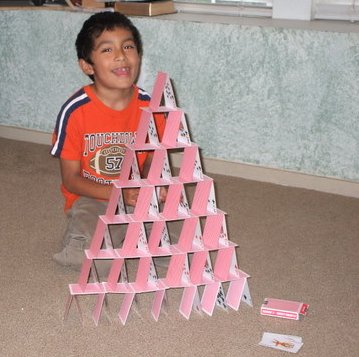
Playing cards are useful for so many things, We play number games, of course. They can be quite the tool to teach numbers to beginners. My older Lambies like to play poker, blackjack and "Doubt It". We all play "Spike and Mallet". I really enjoyed cribbage as a teen and young adult. I need to brush up on it and teach it to the Lambies. I have one, however, that is much more interested in the building properties of cards. He's trying to learn how to challenge this guy.

DSCF7143

Friday, January 22, 2010

Math-U-See Fun

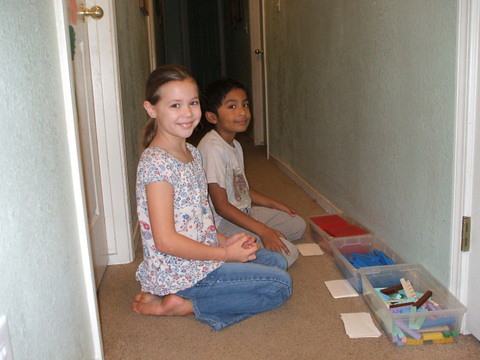
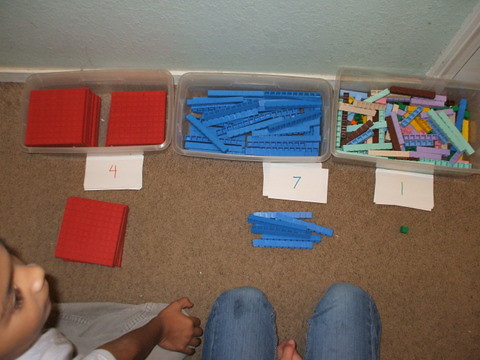
Polly and Jack played a fun little MUS game today I thought I'd share with you. This game develops counting, an understanding of place value and skills in saying large numbers.

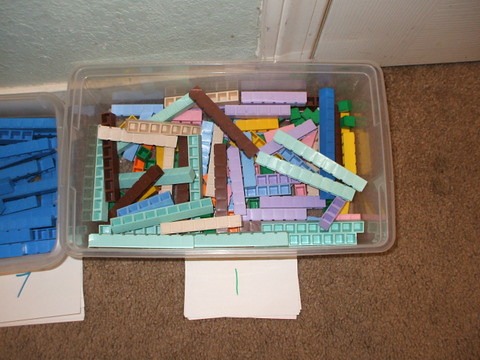
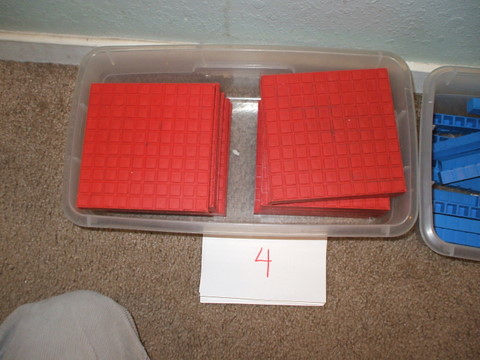
To prepare, gather unlined 3x5 index cards. Write the digits 0-9, one on each card, first in green ink, then again in blue ink and finally in red ink. These represent the colors of the MUS blocks and help them grasp place value.

Then, grab a couple of cute Lambies and set up the activity. Put the cards in separate piles. We keep the MUS block in plastic shoeboxes, and it works well with this game to separate the blocks into three groups.

DSCF7067

Put the piles of cards in front of the appropriate box and turn the top card over.

DSCF7070

DSCF7069

DSCF7068

Now have the child build the correct number and say it aloud.

DSCF7071

It's really a simple thing that keep kiddos busy for quite a while, and is easily scaled back to just counting for a younger child. You can also make it harder by adding addition and subtraction problems for them to build and solve or by mixing the blocks all together and shuffling the cards together so they must place them in proper order themselves.

Tuesday, January 12, 2010

The Dangers of Homeschooling

Jack, seven and a half years old, to Troubles, age four:

"What's three plus three?"

"Six"

"Nope, thirteen!"

Momma: "Don't teach him math anymore, Jack!"